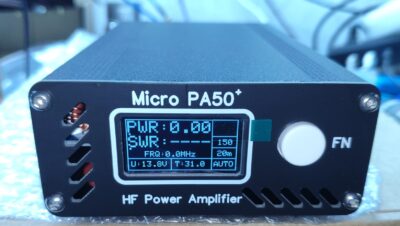
I have a number of QRP rigs, mostly home built, generally with an output of 1.5-5w. In some I’ve built a linear amplifier to bring their output up to 10-25w. I thought it would be more flexible to buy a commercial HF amplifier and so I bought a Micro PA50 Plus which is a 50 watt amplifier covering 80m-10m bands taking 1-5 watts input. It has RF sensing with a configurable attack speed of 100-800ms but also a ACC port to interface with Icom, Yaesu, Xiegu taking PTT and band data or simple PTT grounding.
The Micro PA50+ is a great size and a good standard of construction but disappointing overall and isn’t meeting the requirements as I’d hoped. It is heavily software driven (as most equipment is these days) and its logic is based on updatable firmware and so some of those issues may be resolved in time.
- Fan noise – is far too loud in the shack although if you’re doing SOTA etc then it is probably acceptable.
- Erratic SWR measurement. When there is already a good SWR match (measured on other equipment) the linear shows SWR measurements going all over the place. It limits output over a SWR of 2 and worse, if SWR goes above 3 it will lock up in protection mode and you have to power off and back on again.
- ACC port is unusable for simple PTT linking.
Fan Noise
This was reasonably easy to fix by just putting a resistor in series with the fan. I used 33ohm which drops the voltage and so noise to an acceptable shack level.

Erratic SWR
It might have some bugs but its erratic SWR seems mostly about RF getting in through the power leads and the ACC port. Some have had success putting a resistor in parallel with R36. Various values have been suggested. I tried that but don’t think that is the way forward.
I had already put type 31 ferrite clamps on the inputs outside the case but I had to open the amplifier and put more on the leads inside the box too. This made a significant improvement but you still see more fluctuations in SWR than can be plausible.
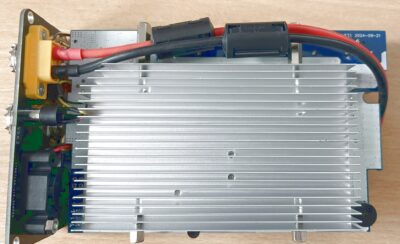
ACC port
I have tried type 31 ferrite clamps on a short connecting cable to the ACC port but this only helped slightly. It is clear that the ACC port is very susceptible to RF which for an HF amplifier isn’t great! If it was more usable it would hold the Linear’s TR relay but as it isn’t you’re left with a VOX scenario with distracting relay clicks all the time.
Conclusion
I’ve given up trying to use this amplifier for the purpose I bought it for, namely to go with a home constructed QRP transceiver. It might do a little better with a commercial transceiver assuming better filtering however I know my transceiver is reasonably well filtered. So instead I’ve repurposed a linear amplifier that I built in 2012 which was integrated into an AM transmitter project.
The linear I built is far more useable!